An AI-searchable memory, with officials in charge
An AI-assisted institutional archive for Simhastha Kumbh Mela 2027. Every letter, minute and order, from receipt to cited answer.
Operational needs and challenges
Simhastha is coordinated through correspondence. Every commitment, approval and instruction sits in a letter or a minute, and has to be found, read and acted on correctly. An archive that serves officials needs six things, each with a known obstacle.
| Operational need | What gets in the way | How the Tracker answers |
|---|---|---|
| 1Find it fast | Thousands of pages across inboxes, files and folders; nobody remembers the file name or date | Ask in plain language; the right letter is found even without its name or date |
| 2Read every page | Scanned letters can't be searched; Marathi and English mixed in one file | Scanned and Marathi pages are read and translated; the original is kept alongside |
| 3Trust the answer | A summary without its source can't be quoted in a meeting or a reply | Every answer cites its letters; the source PDF opens beside it |
| 4Catch commitments | Deadlines and instructions sit in paragraph four of a long letter | Action items extracted with owner and date, tagged by criticality |
| 5See the whole picture | Each department holds only its side of a conversation | Related letters, people and projects connected across departments |
| 6Keep the memory | Transfers take the context of past decisions with the officer | Every document and summary kept on record for the Mela and after |
One flow from letter to answer
The Archive Tracker is an AI-assisted institutional archive: it takes every inter-department letter from upload to a cited answer, and officials verify against the source.
Nothing is entered twice, and every answer points back to the original letter.
| Stage | What happens |
|---|---|
| 1Upload | Letters, MoMs, notices and orders added, scanned or digital, from any departmentKept on record: the original PDF and its date. |
| 2Read | Every page read, including scans; Marathi translated into EnglishKept on record: the readable text and translation. |
| 3Understand | Key details such as sender, departments, amounts and dates capturedKept on record: a summary of the document. |
| 4Act | Instructions and deadlines become action items, auto-tagged by criticalityKept on record: action items and alerts. |
| 5Connect | Related letters, people and topics connected into a shared knowledge baseKept on record: knowledge pages. |
| 6Answer | Officials ask, read the cited answer, open the source and draft a replyKept on record: the reply letter, saved back as PDF. |
A glimpse of the portal
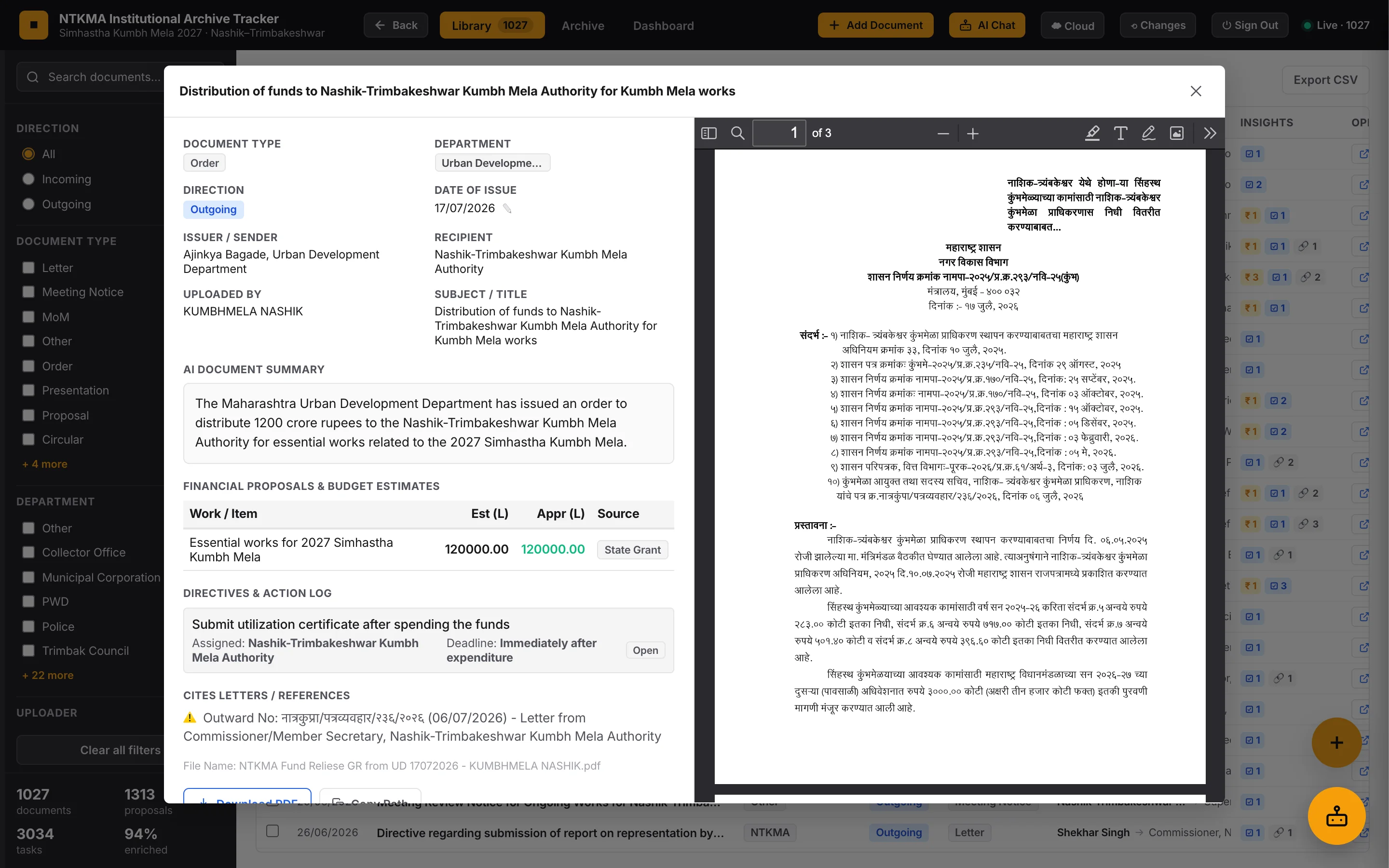
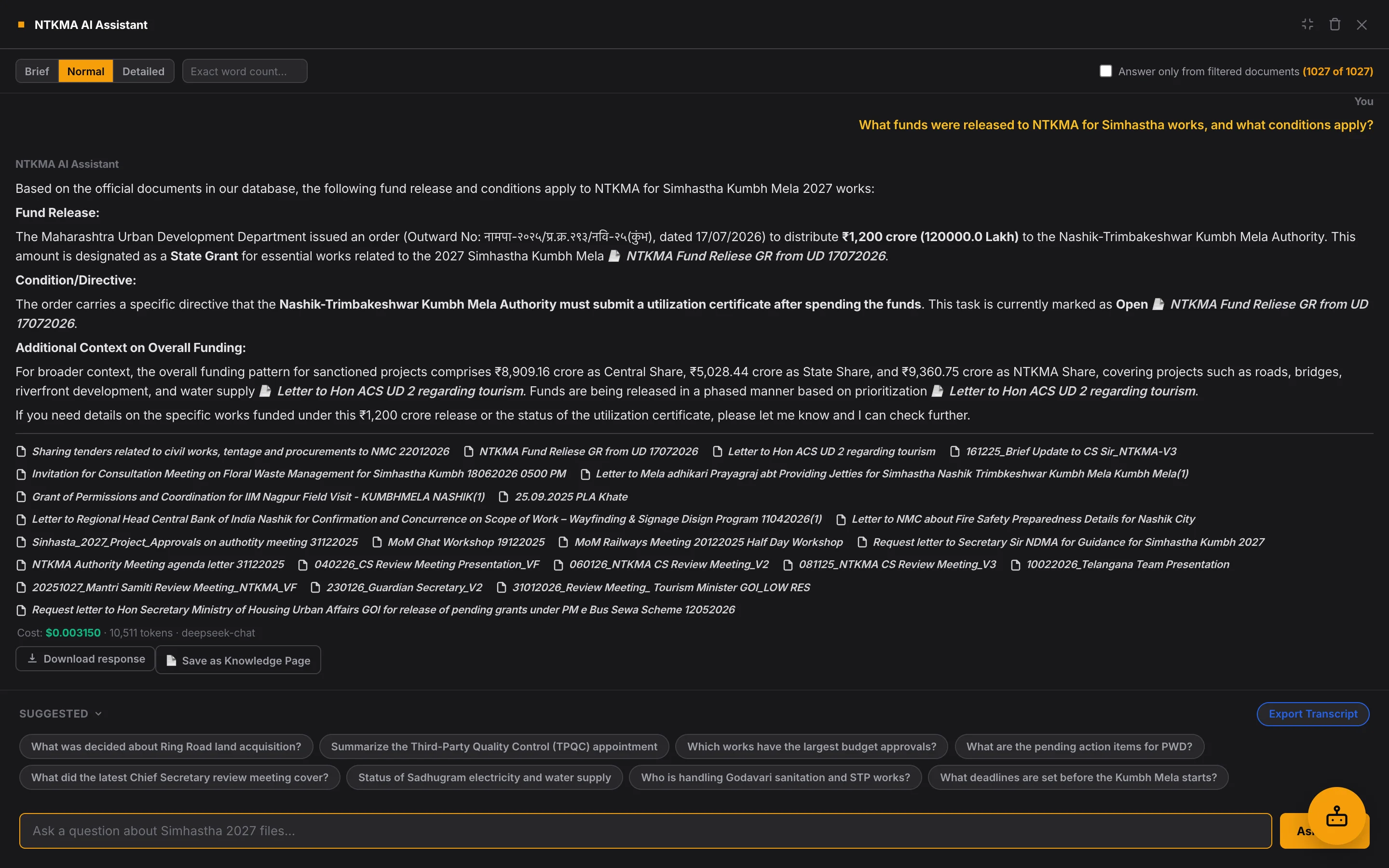
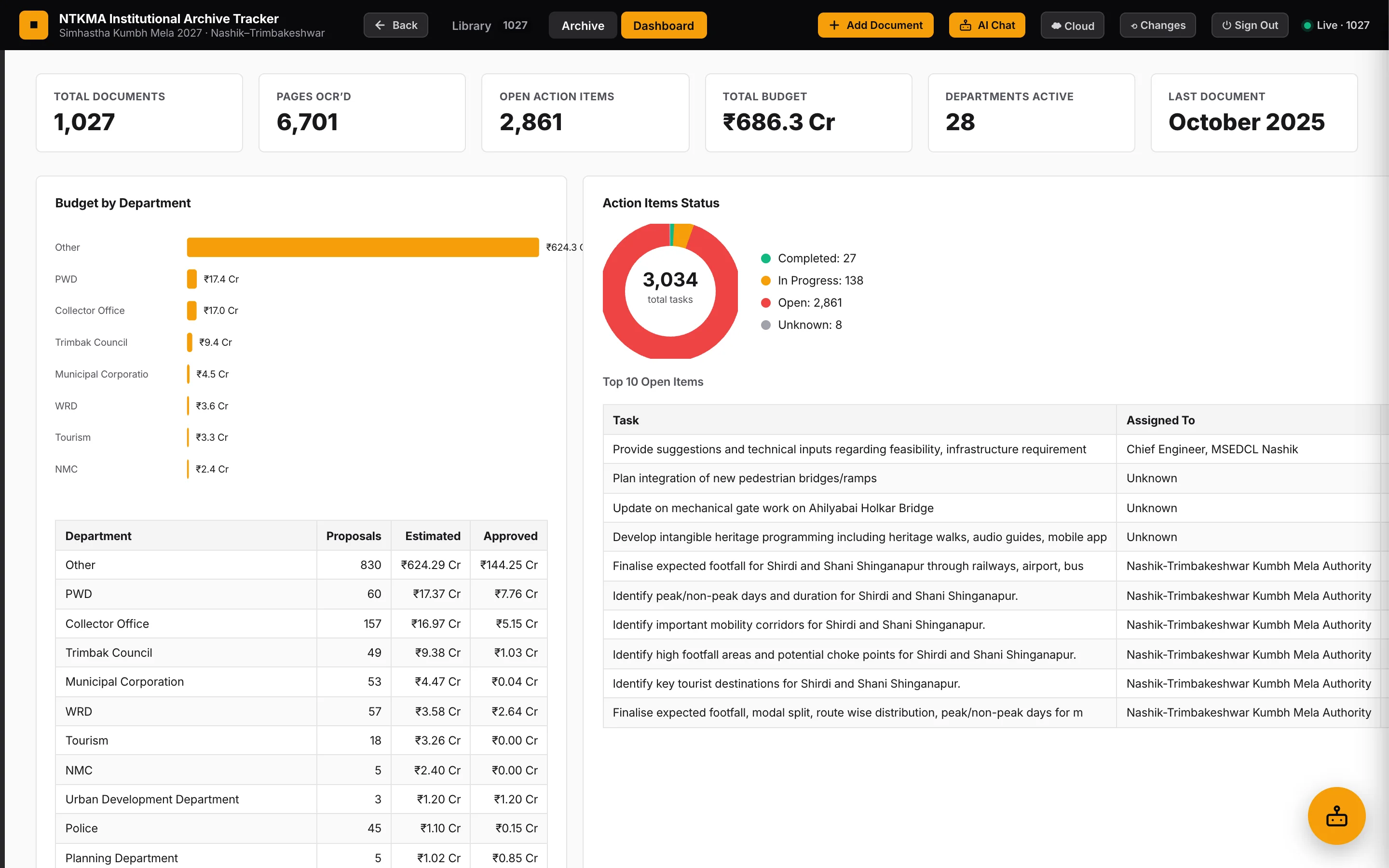
Key unique selling points: what sets it apart
Illustrative answer view: the question, a written answer, and the letters it was drawn from, each one click away.
Commitments: what a department agreed to, and by when
Approvals: which meeting approved a budget or design
Follow-ups: open action items for a project or officer
Replies: a draft response to a letter just received
Answers cite the letters they came from; the PDF opens alongside, so a claim is checked in seconds
No file name, date or sender needed
Scanned and Marathi letters are read too, so nothing is left out by format or language
Action items pulled from every letter with owner and deadline; critical ones raised on the dashboard
People, projects and proposals linked so a decision can be traced end to end
Ask about one open letter, or select a passage and ask about just that
Draft a response from the original's context; everything kept for the Mela and after
Four things to take away
Findable
Any letter, minute or order in under a minute, asked in plain language.
Traceable
Every answer cites its source, which opens beside it for checking.
Complete
Scanned and Marathi pages read, so nothing is missed by format or language.
Lasting
Institutional memory that stays when officers move on.